

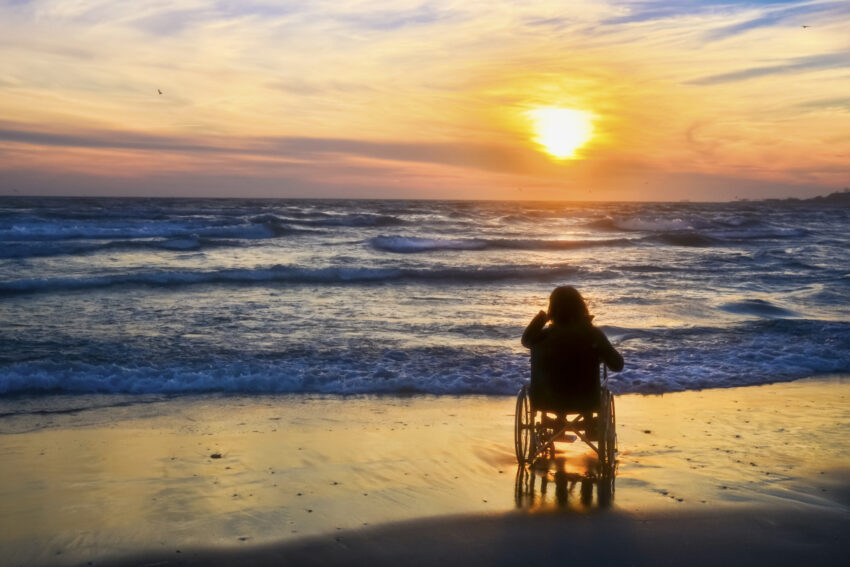
Could a life-changing accident be a gift from God?
by Cynthia Ann Robinson-Glass as told to Priscilla Tate Gilmore
On Sunday, January 30, 1977, I met up with a friend at the Washington Park Arboretum in Seattle. We talked about what had happened since graduating from high school.
I didn’t know it would be my last walk, that I was about to take a journey I never imagined could happen to me at the young age of twenty-one.
Agenda
Monday morning I woke to an overcast sky and light rain sprinkling the city. My agenda for the day was to drive to Seattle and run errands.
I climbed in my blue Rambler American and headed toward the Old Mercer Island Bridge, thinking about my night classes at Seattle Pacific University, work at Nordstrom’s during daylight hours, and the trip ahead of me to the United Airlines Flight Attendant School in Minneapolis. Life was good. Busy.
Collision
Traveling in one of the two lanes going east on the bridge toward Seattle, I slowed down due to wet pavement. My car hydroplaned, causing me to make a 180 degree turn and stop abruptly.
Now facing west, toward home and fully conscious, I looked in my rearview mirror and screamed, “Oh, God!” I saw the front of a semi-truck pulling a set of doubles approaching from Seattle’s tunnel.
Within seconds, the second trailer jackknifed and hit my gas tank. Not wearing a seatbelt, I flew to the right and hit my back on the door handle, one leg on the car seat and the other on the floorboard. The driver of the truck stopped in the lane next to me.
Oh God, please don’t let there be a gas leak. Please help the fire department to come quickly.
Medical help
I recognized a bystander, flagged him over, and gave him my parents’ number.
The fire department arrived shortly. Recognizing the position of the trailer and my car, a fireman jumped from his vehicle, shouting, “We need to get the woman out of the car!”
When all possible evidence of a fire was removed, paramedics were amazed that I was awake and talking. I felt no pain in my chest until they lifted me onto the gurney and slid the stretcher into the ambulance. After sharing my name and address, I anticipated a short visit to Harbor View Hospital.
Injury report
In ICU, I had no idea there was a fifty-fifty chance I would live or die. Mom and Dad didn’t know how to deal with all of this. Devastated that such a thing could happen to their little girl, they prayed and tried to remain positive.
After I stayed in ICU for two weeks, my vitals stabilized. However, an x-ray revealed that my back had been injured at T7 (the seventh thoracic vertebra) and showed an incomplete injury in the middle of the spine. This area helps hold up the upper body and protect the spine’s vertebral column.
Surgery
In surgery on February 14, the surgeon inserted two Harrington rods (stainless steel devices) and attached them on each side of the vertebra at T2 and T12.
I woke from surgery with no feelings of fear, hate, or despair. But then, I didn’t understand everything going on.
Stabilization
I was placed in a plaster cast from my neck to my hips and wore it for two or three months until my back stabilized. After that, I was fitted with a plastic cast that looked like a turtle shell, with latches on either side so I could open and close, move, and shower.
While my body was confined, my mind hung in a state of limbo, uncertain about the future. I coped with the routine: Wake up at 7:00 a. m., nurses and doctors constant care, and medications. Repeat the next day.
Rehab
Finally after two months, still in the shell, I was transported to the University of Washington for rehabilitation. I had no idea what it would look like or what I should expect.
In rehab, things I had taken for granted became chores. Before my accident, it took no thought to move from bed to chair. Now, with no working legs, I had to transfer from a prone position to my wheelchair.
“Jesus, help me,” I prayed out loud. I picked up the left leg, took it off the bed. Then I repeated the procedure with the right leg. Now seated on the bed, I pushed off, balanced over the arm of the manual wheelchair, and lifted myself onto the chair and sat. Accomplishing the assignment was exhausting but satisfying.
I learned other maneuvers but felt like an exhibit in the zoo with so many nurses, doctors, and physiatrists watching. Unnatural. Humbling.
Piano performance
A physiatrist visited me. He had never met anyone with my positive mindset. “How can I help you?” he asked.
“I need something to do,” I answered. “I’ve performed in piano recitals. Is there a piano I can use?”
A piano, he said, was on the psych floor.
Several times a week, for my mental well-being, I went upstairs, replaced the piano bench with my wheelchair, and played for patients with serious mental issues. I looked around at those listening. Having a mental problem is almost worse than having a physical disability.
Pool exercise
After performing, I told the doctors I was a synchronized swimmer and tennis player, and had passed over hurdles on a track team. Meeting challenges was not foreign to me.
A physical therapist arranged for me to go on a bus to a pool. In water ballet, I had used my legs. But now with no movement in the lower part of my body, a paraplegic (though not confirmed by doctors), my focus was to strengthen and use my upper torso.
Sharing Scripture
In one of my time alone moments, a minister visited me and shared Jeremiah 29:11: “‘For I know the plans I have for you,’ declares the Lord, “plans to prosper you and not to harm you, plans to give you hope and a future.”
Wanting more, I clung to the words future and hope.
Hungering for God
Growing up, my parents took me to church in Bellevue, Washington. I read the Bible, attended church Bible school for kids, and the Christian camp in Neskowin Beach in Oregon. At the age of thirteen, I asked Jesus Christ to come into my heart. But honestly, I didn’t understand what it meant to have a real, personal relationship with Him.
Truly hungry for God now, I prayed, “Jesus, I recognize that You are the Son of God and that You died in my place for all my sins. Come into my heart and forgive my sins.”
Plan and purpose
Now I understood God had been with me in the accident and spared my life for a reason. I knew He loved me and had a different plan from the life I was living. My purpose was to trust Him for every step and leave the outcome in His capable hands.
My new way of thinking overshadowed the pain I had been through. I could’ve had a pity party. Remembering the past, I sometimes did. I missed my body, the ability to walk, to do anything. I wouldn’t ever be the person I was. But I purposed to say, “OK, God, I am here in this wheelchair. Please entwine this suffering with joy so they work together.”
I chose to hide Romans 5:3, 4 in my heart: “We also glory in our sufferings, because we know that suffering produces perseverance; perseverance, character; and character, hope.”
Release
On the day of my release in mid-August, twelve people who had been assigned to my life, as well as my mother and father, sat around a table. Dr. Bergman told me that they didn’t know the outcome of my injury at T7. He ended with “Today you are going home in a wheelchair, but you could gain some function.”
Dr. Bergman never referred to me as a paraplegic; maybe they were afraid of a lawsuit. But I knew I was.
How was I going to deal with my forever situation? Be depressed? After looking out the window and seeing God’s rainbow in the sky, my decision was to switch my brain. “With God’s help,” I said, “I can handle this.”
Finding a normal life
After being discharged from the hospital, I suffered through valleys and experienced joy on mountaintops. I went to graduate school, with my parents and friends transporting me, and overcame hurdles. (The Americans with Disabilities Act was not signed into law until July 26, 1990.)
I married, divorced, taught at the community college in Medford, Oregon, married again in 1986, and volunteered at the deaf school in Salem, Oregon, before it closed.
Blessed assurance
Today at seventy years old and having sat in a wheelchair for forty-eight years, I still struggle with how to navigate the unexpected twists and turns of life.
However, I choose many times a day to remember that Jesus Christ, who gave Himself for me, is sovereign and trustworthy. The One who has assured me of eternal life helps me daily to live for Him, no matter the circumstances. The more I rely on His wisdom, the deeper my heart travels with God and His words. His love for me is more that I can ever realize. I have vowed to trust my Jesus until my last breath.
One of the passages I cling to is Isaiah 46:3, 4:
“Listen to me, you descendants of Jacob, all the remnant of the people of Israel, you whom I have upheld since your birth, and have carried since you were born. Even to your old age and gray hairs I am he, I am he who will sustain you. I have made you and I will carry you; I will sustain you and I will rescue you.”
Unexpected gift
Growing up in Jesus is a process that continues. Surviving the accident and eight months in the hospital and rehab was a gift that taught me that my life is not in my hands. I have no control.
Through this experience, I have learned how to have a humble reliance on God for everything.
Doctor’s name has been changed.
Scripture quotations are taken from the New International Version.
Priscilla Tate Gilmore has two adult children and continues to write from Salem, OR. Her book The Suitcase is a teen novel that speaks to the heart of everyone who reads the story.